Colorful Carbon Fiber vs Black Carbon Fiber: What’s the Difference?
Colorful carbon fiber is changing how brands, designers, and manufacturers use carbon fiber materials. This guide explains how colored carbon fiber is made, how it compares with black carbon fiber, and where it makes the most sense.
Colorful carbon fiber is no longer only a decorative idea. With the right manufacturing method, colored carbon fiber can be integrated into the material itself, creating carbon fiber plates and custom parts that are visually distinctive, durable, and suitable for real product development.
Walk into any room where carbon fiber products are displayed and you will notice something immediately: almost everything is black. Black has been the default color of carbon fiber since the material was first commercialized. For a long time, that was accepted as a fundamental property of the material.
But today, colorful carbon fiber exists — and it is making a significant impact across automotive, luxury goods, electronics, accessories, and custom component manufacturing.
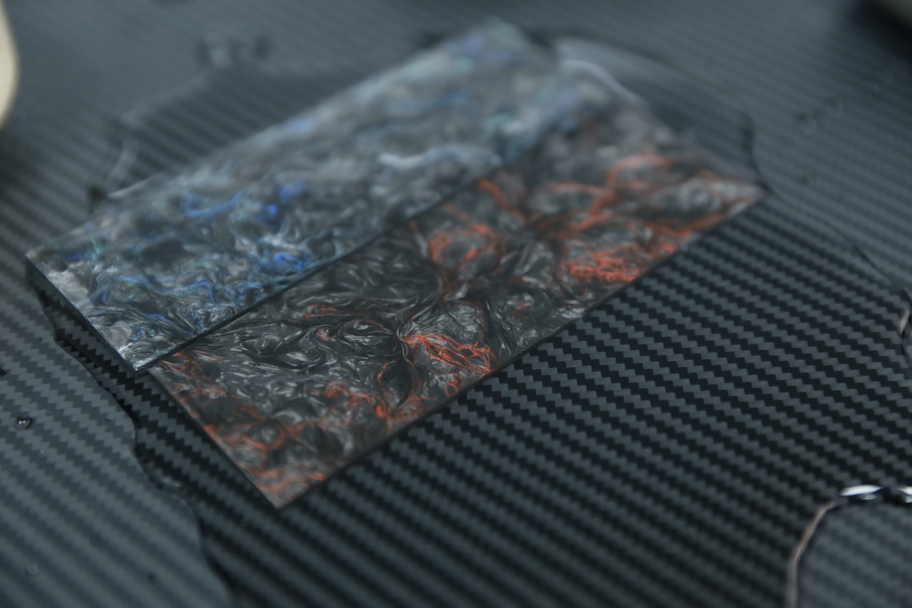
In this article, we break down exactly what colorful carbon fiber is, how the color is achieved, whether it performs as well as black carbon fiber, and where it makes sense to use it.
Why is Carbon Fiber Black?
To understand colorful carbon fiber, it helps to first understand why carbon fiber is black in the first place.
Carbon fiber filaments are produced through high-temperature conversion of precursor materials, commonly including polyacrylonitrile, also known as PAN. During this process, the material is transformed into carbon-rich fibers with a highly ordered structure. For a technical overview of carbon fiber precursor conversion and research, you can refer to Oak Ridge National Laboratory’s carbon fiber research.
Black is the natural visual state of carbon fiber. Standard carbon fiber is not dyed or coated to become black. Its carbon structure absorbs most visible light, which is why carbon fiber naturally appears black.
This is also why early attempts to create colored carbon fiber were difficult. You cannot simply dye carbon fiber the way you would dye a textile. If the color only sits on the surface, it will not become part of the material itself.
How is Colorful Carbon Fiber Made?
There are several approaches to producing colored carbon fiber materials, ranging from simple surface treatments to deeper material integration. The difference between these methods is very important for durability, machining, and long-term product quality.
Surface Coating or Paint
A colored lacquer, paint, or coating is applied to the surface of a finished carbon fiber panel.
- Color exists only on the surface
- Scratches, chips, and fades over time
- Machining exposes black edges
- Limited UV, heat, and abrasion resistance
Colored Resin
The resin used to bind the carbon fiber is tinted with color pigment and distributed through the resin matrix.
- Color depth is limited
- Black carbon fiber still dominates the look
- Bright colors are difficult to achieve
- Batch-to-batch consistency can vary
Colored Fiber Integration
Colored fiber strands are blended directly with carbon fiber strands before the material is formed.
- Color exists through the full thickness
- Consistent color after cutting or sanding
- Bright, saturated colors are possible
- No surface layer to peel or fade
Method 1 — Surface Coating or Paint
This is the simplest and least durable approach. A colored lacquer, paint, or coating is applied to the surface of a finished carbon fiber panel.
The problem is that the color lives only on the surface. It may scratch, chip, or fade over time. When the material is cut, CNC machined, or sanded, black carbon fiber is exposed at the edges. This method is common in low-cost decorative products, but it is not suitable for quality manufacturing.
Method 2 — Colored Resin
In this approach, the resin used to bind the carbon fiber is tinted with color pigment. The color is distributed throughout the resin matrix.
This is better than surface coating, but it still has limitations. The black carbon fiber strands continue to show through strongly, which makes bright or saturated colors difficult to achieve. Color consistency can also vary between batches.
Method 3 — Colored Fiber Integration
This is the most advanced approach and the method Carbonaurum uses. Colored fiber strands are blended directly with carbon fiber strands before the material is formed. The color becomes part of the material structure and is distributed throughout the full thickness.
This is the key difference: with color-integrated forged carbon fiber, the color does not sit on the surface. It remains visible when the material is cut, machined, sanded, or shaped into finished parts.
Does Colorful Carbon Fiber Perform the Same as Black Carbon Fiber?
This is the most important question for engineers, product designers, and manufacturers. The honest answer is: it depends on how the color is made.
Surface-coated or painted carbon fiber has the same underlying carbon fiber structure, but the color is only cosmetic and can be damaged. For fiber-integrated colorful forged carbon fiber, the comparison is more practical because the color is part of the material system.
| Property | Black Forged Carbon Fiber | Colorful Forged Carbon Fiber |
|---|---|---|
| Tensile strength | Baseline | Comparable for intended applications |
| Flexural rigidity | Baseline | Comparable |
| Impact resistance | Baseline | Comparable |
| Surface hardness | Baseline | Comparable |
| UV resistance | Good | Good |
| Color durability | Not applicable | Excellent when color is integrated into the material |
| Edge color consistency | Black at all depths | Colored at all depths |
The inclusion of colored reinforcement fibers in our blend does not significantly compromise the mechanical properties of the final material for the applications we serve, including consumer products, luxury goods, automotive trims, electronics housings, accessories, and custom components.
For pure structural aerospace or motorsport applications where maximum fiber-direction strength is the only priority, standard black carbon fiber remains the engineering choice. But for the vast majority of commercial applications, colorful forged carbon fiber delivers equivalent practical performance with dramatically expanded design capability.
Carbon fiber has already been used in high-performance applications where lightweight construction matters. For example, Lamborghini describes the Sesto Elemento as using advanced carbon fiber technology to achieve extremely low weight. You can view the official reference here: Lamborghini Sesto Elemento official page.
Visual Comparison: What Does Colorful Forged Carbon Fiber Look Like?
One of the most compelling aspects of colorful forged carbon fiber is its appearance. Because forged carbon fiber has a random, flowing, marble-like pattern, the introduction of color creates effects that are genuinely striking and unique.
No two pieces from the same panel are identical. This makes colorful forged carbon fiber especially valuable for luxury and premium products where material uniqueness is part of the product value.
Subtle & Sophisticated
Dark navy, grey, bronze, or muted tones with slight color variation, similar to meteorite, stone, or mineral textures.
Bold & Graphic
Vivid red, electric blue, green, or purple with high contrast against dark carbon fiber strands.
Multi-Tonal
Blended color systems that shift and move through the forged carbon fiber pattern.
Metallic Effects
Gold, silver, or metallic fiber inclusions that catch light from different viewing angles.
This visual uniqueness is a significant commercial advantage in luxury and premium product contexts. Customers are not just buying a color — they are buying a piece that no one else in the world has.
Where Does Colorful Carbon Fiber Make the Most Sense?
Colorful carbon fiber is most valuable when performance, lightweight structure, and visual differentiation all matter at the same time.
Luxury Goods & Accessories
Color and uniqueness are core value drivers in luxury. Colorful forged carbon fiber delivers both in a single material.
Automotive Interior Trims
OEM and aftermarket customers increasingly want color options beyond black. Colorful carbon fiber delivers premium material aesthetics with brand-customizable colors.
Consumer Electronics
Product differentiation at retail depends on visual distinction. A colorful carbon fiber panel stands out immediately against plastic and aluminum competitors.
Jewelry & Wearables
Lightweight, skin-safe, colorful, and unique — colorful carbon fiber is well suited for modern jewelry and wearable product design.
Sporting Goods
Team colors, brand palettes, and limited editions become easier to develop with colored forged carbon fiber materials.
Custom Components
Colored plates, panels, blocks, and CNC-machined parts can support unique industrial design and product branding.
Less Suitable Applications
- Pure structural aerospace components where maximum directional fiber strength is required and cosmetics are not important.
- High-temperature environments above 150°C sustained where epoxy resin systems may reach their thermal limits.
How to Specify Colorful Carbon Fiber for Your Project
If you are considering colorful carbon fiber for a product, defining the right parameters early will help the supplier recommend the best material specification and production method.
At Carbonaurum, we work with clients from initial color concept through to production supply. Custom color development is available for brands that require exclusive colorways.
Conclusion
Colorful carbon fiber is no longer a novelty. It is a mature manufacturing material with proven performance and growing adoption across multiple industries.
The key is in how the color is made. Surface coatings are a compromise. True color-integrated forged carbon fiber, where color lives inside the material from edge to edge, is in a different category entirely.
If you have been designing around the limitation of black carbon fiber, it may be time to reconsider what is possible.
Need Colorful Carbon Fiber for Your Product?
Carbonaurum supplies colorful forged carbon fiber plates, sheets, panels, and custom parts for product designers, brands, and manufacturers. We can provide color samples and discuss your project requirements.