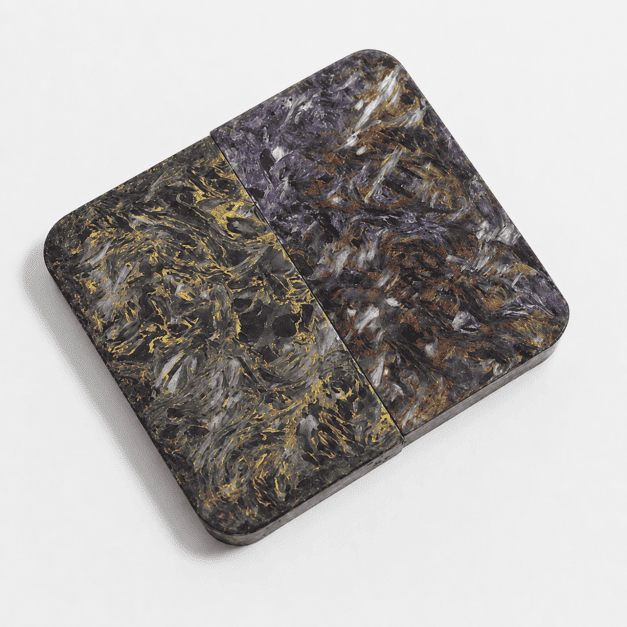
What is Forged Carbon Fiber? The Complete Guide
A practical guide to forged carbon fiber: what it is, how it is made, how it compares with traditional woven carbon fiber, and why it is becoming a preferred material for automotive, luxury goods, consumer electronics, and custom product applications.
What is forged carbon fiber? Forged carbon fiber is a high-performance composite material made from chopped carbon fiber strands and resin, compressed under heat and pressure into plates, sheets, or custom molded parts.
In this guide, we cover what forged carbon fiber is, how it is made, how it compares to traditional woven carbon fiber, and why it has become a material of choice for automotive, luxury goods, consumer electronics, jewelry, and premium accessories.
What is Forged Carbon Fiber?
Forged carbon fiber is a composite material made from chopped carbon fiber strands mixed with resin, then compressed under high heat and pressure into sheets, plates, or net-shape components.
Unlike traditional carbon fiber, which uses woven fabric sheets laid up in specific orientations, forged carbon fiber uses randomly oriented short fiber strands. This gives the finished material its signature characteristic: a random, flowing, marble-like pattern that is visually distinct from the familiar grid weave of conventional carbon fiber.
The word “forged” refers to the compression molding process. The concept is similar to how metals are forged under pressure, except the material here is a fiber-resin composite rather than metal.
A Brief History of Forged Carbon Fiber
Forged carbon fiber was first developed by Lamborghini and Callaway Golf in a joint research project in the mid-2000s. The original goal was to find a faster and more cost-effective way to produce complex carbon fiber shapes compared with traditional hand layup methods.
The result was not only a new manufacturing approach, but also a completely new visual language for carbon fiber. Lamborghini later showcased this distinctive material aesthetic in the Sesto Elemento concept car in 2010.
Since then, forged carbon fiber has moved far beyond supercars. Today, it can be found in luxury watches, consumer electronics, sporting goods, jewelry, accessories, and premium custom components worldwide.
How is Forged Carbon Fiber Made?
The production of forged carbon fiber involves several key steps, from preparing the raw fiber to compression molding and final finishing.
Chopping the Carbon Fiber
Raw carbon fiber tow is chopped into short strands, typically between 10mm and 50mm.
Mixing with Resin
The chopped fibers are combined with a high-performance epoxy resin system.
Loading the Mold
The fiber-resin mixture is placed into a precision steel mold for forming.
Compression Molding
Controlled heat and pressure cure the resin and compact the fiber mixture.
Demolding & Finishing
The cured part is trimmed, sanded, coated, or polished to the required finish.
Step 1 — Chopping the Carbon Fiber
Raw carbon fiber tow, which consists of bundles of thousands of individual filaments, is chopped into short strands. The fiber length affects both the mechanical performance and the visual texture of the final material.
Step 2 — Mixing with Resin
The chopped fibers are combined with a high-performance epoxy resin system. The ratio between fiber and resin must be carefully controlled: too much resin can reduce strength, while too little resin can create voids and processing defects.
Step 3 — Loading the Mold
The fiber-resin mixture is placed into a precision mold. Unlike woven carbon fiber layup, forged carbon fiber does not require careful fabric cutting, orientation alignment, or manual overlapping.
Step 4 — Compression Molding
The mold is closed and subjected to controlled heat and pressure. The heat activates and cures the resin, while the pressure compacts the fiber mixture, helps eliminate voids, and ensures proper fiber wet-out.
Step 5 — Demolding and Finishing
After curing, the part is removed from the mold and finished. Depending on the application, it may be trimmed to size, sanded, CNC machined, polished, or coated with a clear resin or lacquer to achieve the desired surface quality.
Forged Carbon Fiber vs Traditional Woven Carbon Fiber
One of the most common questions is how forged carbon fiber compares with traditional woven carbon fiber. The answer depends on the application, geometry, strength requirements, and design goals.
| Property | Woven Carbon Fiber | Forged Carbon Fiber |
|---|---|---|
| Fiber orientation | Directional, such as 0°/90° or ±45° | Random, multi-directional |
| Visual pattern | Regular grid weave | Random marble-like texture |
| Complex shape capability | Limited; fabric must be cut and overlapped | Excellent; material can flow into mold geometry |
| Production speed | Slower, often manual layup | Faster, based on compression molding |
| Directional strength | Very high in the fiber direction | Moderate but consistent in multiple directions |
| Impact resistance | Can delaminate on impact | Better multi-directional impact behavior |
| Color options | Usually black in standard form | Available in multiple color systems |
| Each piece unique? | No, the pattern is uniform | Yes, every piece has a unique texture |
| Cost at scale | Higher for complex parts | Lower for suitable production volumes |
Which is stronger?
This depends on the application. Woven carbon fiber has higher strength in the direction of the fibers, making it suitable for structural aerospace and motorsport applications where the load direction is known and carefully controlled.
Forged carbon fiber has more consistent strength in multiple directions, making it better suited for applications where the material experiences multi-directional stress, complex shapes, or situations where the exact load direction cannot be precisely predicted.
For decorative, semi-structural, and consumer product applications, forged carbon fiber is frequently the more practical and visually distinctive choice.
What is Colorful Forged Carbon Fiber?
Standard forged carbon fiber is black, which is the natural color of carbon fiber strands. However, recent manufacturing advances have made it possible to produce forged carbon fiber in a wider range of colors.
At Carbonaurum, we have developed a process that integrates color directly into the fiber matrix — not as a surface coating or paint, but as part of the material itself.
The result is colorful forged carbon fiber that:
Retains its color when cut, machined, or sanded; does not fade, peel, or chip like a surface coating; maintains the structural performance of standard forged carbon fiber; and produces unique color-pattern combinations in every single piece.
This innovation has opened forged carbon fiber to new product categories, including colored automotive trims, vivid electronics housings, jewelry, luxury accessories, and custom parts where standard black carbon fiber may not match the desired product identity.
Key Advantages of Forged Carbon Fiber
Design Freedom
Forged carbon fiber can fill complex molds and create curved surfaces, undercuts, and three-dimensional shapes that woven fabric cannot easily achieve.
Unique Aesthetics
Every piece has a different pattern, creating a genuine material rarity that adds value in luxury and premium product contexts.
Lightweight Performance
Forged carbon fiber is significantly lighter than aluminum, steel, and many engineering plastics while maintaining excellent rigidity.
Scalable Production
The compression molding process is faster and more automated than hand layup, making forged carbon fiber suitable for production volumes.
Advanced Color Options
With Carbonaurum’s manufacturing technology, forged carbon fiber can be produced in a wide range of colors for new design possibilities.
Custom Part Potential
The material is suitable for plates, panels, blocks, molded parts, CNC-machined components, and OEM product development.
Common Applications of Forged Carbon Fiber
Forged carbon fiber is used across a wide range of industries where lightweight performance, design flexibility, and premium aesthetics are important.
Frequently Asked Questions
Is forged carbon fiber real carbon fiber?
Yes. Forged carbon fiber uses the same carbon fiber raw material as woven carbon fiber. The difference is in how the fibers are processed and formed into the final material.
Is forged carbon fiber stronger than woven carbon fiber?
It depends on the application. Woven carbon fiber is stronger in the fiber direction, while forged carbon fiber is more consistent across multiple directions. For most consumer, decorative, and semi-structural applications, forged carbon fiber performs very well.
Why does forged carbon fiber look different from regular carbon fiber?
The random orientation of chopped fiber strands creates a flowing, marble-like pattern instead of the regular grid pattern of woven carbon fiber fabric.
Can forged carbon fiber be colored?
Yes. With the right manufacturing technology, forged carbon fiber can be produced in different colors. Carbonaurum specializes in colorful forged carbon fiber with color integrated directly into the material matrix.
How thick can forged carbon fiber panels be?
Panels can be produced from very thin sheets to thicker blocks, depending on application requirements, machining needs, and product design.
Conclusion
Forged carbon fiber is no longer a niche aerospace material. It has become a practical manufacturing choice for applications that demand lightweight performance, design flexibility, and premium aesthetics.
With the development of colorful forged carbon fiber, the material’s reach has expanded even further into luxury goods, jewelry, consumer electronics, automotive trims, and custom OEM parts where color, uniqueness, and quality matter.
Evaluating Forged Carbon Fiber for Your Next Product?
Carbonaurum supplies forged carbon fiber plates, colorful carbon fiber materials, and custom carbon fiber parts for product designers, brands, and manufacturers. We can provide samples and discuss your specific material requirements.