
Forged Carbon Fiber Sheet vs Plate vs Block: Which Material Form Should You Choose?
A practical buyer’s guide comparing forged carbon fiber sheet, carbon fiber plate, and carbon fiber block for CNC machining, fabrication, inlay work, structural panels, jewelry, watches, knife scales, and custom carbon fiber components.
When buyers search for forged carbon fiber stock for machining, fabrication, or inlay work, they often see three terms used inconsistently across suppliers and product listings: sheet, plate, and block. In some catalogs these terms overlap. In precision manufacturing, however, the choice of starting form directly affects material waste, tooling strategy, machining time, and finished component quality.
This article defines each form clearly, explains how each behaves under machining, and gives a practical decision framework for choosing the right forged carbon fiber material form for your application. Whether you need forged carbon fiber sheet for flat panels, carbon fiber plate for structural parts, or carbon fiber block for three-dimensional CNC machining, choosing correctly makes production easier.
Quick answer: choose forged carbon fiber sheet for thin flat parts, carbon fiber plate for thicker flat parts with structural or fastening requirements, and carbon fiber block for three-dimensional CNC components that require material removal in multiple axes.
| Form | Best For | Typical Machining | When to Choose |
|---|---|---|---|
| Sheet | Thin flat components, panel inlays, decorative surfaces, dial faces, keyboard plates. | CNC routing, profile cutting, drilling, face routing, edge profiling. | Choose sheet when the finished component is flat or near-flat. |
| Plate | Thicker flat components, structural panels, countersunk parts, load-bearing flat members. | Profile milling, countersinking, counterboring, drilling, edge beveling. | Choose plate when sheet geometry is correct but more thickness is required. |
| Block | Three-dimensional components, CNC billets, watch parts, hardware bodies, custom machined parts. | Multi-axis milling, pocketing, contouring, drilling, full 3D material removal. | Choose block when the part has depth in all three axes. |
Defining the Three Forms: Sheet, Plate, and Block
Before comparing applications and machining behavior, it is important to define the three terms. The carbon fiber industry does not always use these terms consistently, and buying the wrong form can increase cost, machining time, and scrap risk.
What Is a Forged Carbon Fiber Sheet?
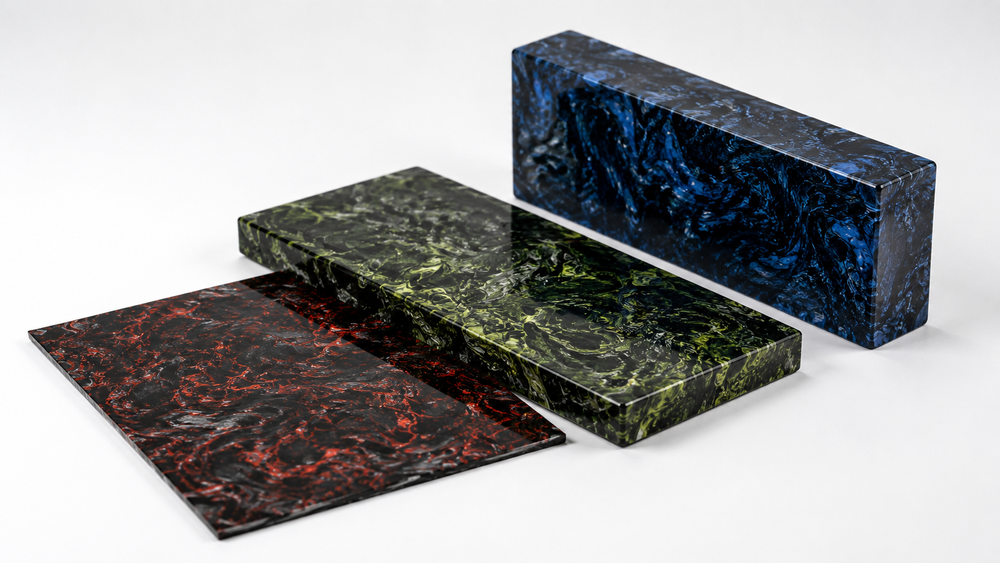
A forged carbon fiber sheet is a flat panel with a large face area relative to its thickness. The defining characteristic of sheet stock is that the two large flat faces dominate the geometry. Most of the usable material is accessed from those faces.
Forged carbon fiber sheet differs from standard woven carbon fiber laminate. Standard laminate sheet is built from layers of woven or unidirectional carbon fiber fabric, creating ply boundaries parallel to the sheet faces. Forged carbon fiber sheet is produced from chopped carbon fiber strands compressed under heat and pressure, forming a three-dimensional random fiber network with no dominant grain direction.
This structural difference matters during machining. Standard laminate can delaminate at cut edges, while Carbonaurum forged carbon fiber sheets are designed for cleaner CNC routing, drilling, edge profiling, and polishing.
For colored forged carbon fiber sheets, color is distributed through the full thickness during the forging process. Every CNC-cut edge, routed profile, and drilled hole exposes consistent through-body color instead of a black carbon fiber cross-section below a surface coating.
What Is a Carbon Fiber Plate?
In most technical and industrial contexts, carbon fiber plate refers to a flat panel with greater thickness than sheet. The plate is still flat, but it has enough thickness to carry structural load, provide a rigid mounting surface, or support fastener installation.
There is no universal standard that separates sheet from plate by one exact thickness. The practical distinction is functional: sheet is primarily a surface or thin component material, while plate is a thicker flat material used when the part needs more depth, stiffness, or mechanical fastening capacity.
In the context of Carbonaurum forged carbon fiber, plate-thickness stock retains the same through-body color behavior as thinner sheet. The difference is in thickness and how that thickness changes structural and machining possibilities.
What Is a Carbon Fiber Block for Machining?
A carbon fiber block is a solid rectangular billet with substantial dimensions in all three axes. It is not simply a thick sheet. A block is used when the finished component is three-dimensional and must be machined from a solid starting billet.
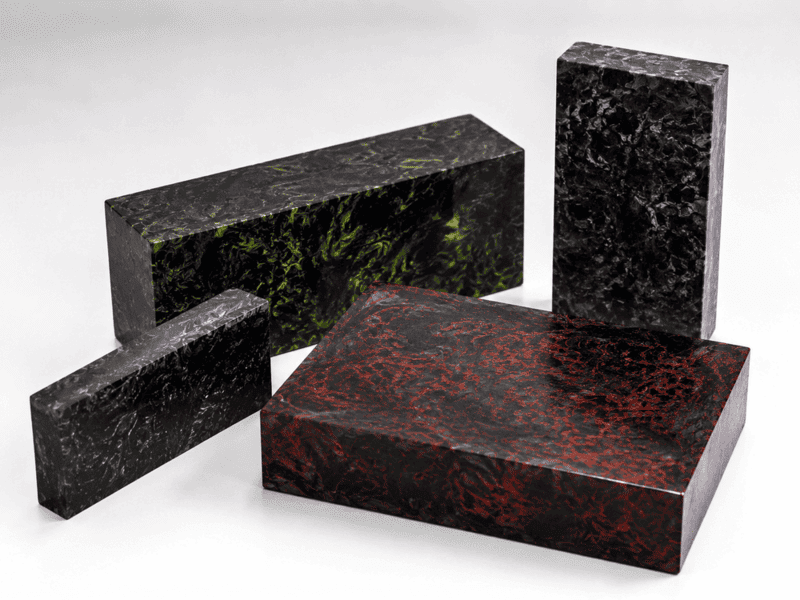
A carbon fiber block for machining is the correct form when your part has significant depth, requires access from more than one face, needs pockets and contours in multiple directions, or cannot be efficiently produced from sheet, plate, rod, or tube stock.
Carbonaurum forged carbon fiber blocks carry through-body color through the full billet. Every face, pocket, contour, and surface produced at any depth of material removal exposes the same color and pattern behavior as the original billet exterior.
Forged Carbon Fiber Sheet: When It Is the Right Choice
Forged carbon fiber sheet is the correct starting form when the finished component is flat or near-flat, and when the main machining operations are profiling, drilling, face routing, engraving-style detailing, and edge finishing.
If your component has no significant depth — such as a watch dial face, decorative panel inlay, flat hardware element, keyboard plate, or architectural surface inlay — sheet is normally the most material-efficient starting form.
Sheet stock also allows efficient nesting of multiple component outlines from one piece. This is especially useful for production quantities of small flat components, such as dial faces, inlay panels, jewelry inserts, or decorative plates.
Typical Applications for Forged Carbon Fiber Sheet
- Watch dial faces and sub-dial inlays
- Decorative panel inlays for furniture, interiors, and luxury goods
- Keyboard plates and mechanical keyboard components
- Ring face inlay panels and flat jewelry inserts
- Consumer electronics decorative panels
- Eyewear frame fronts and temple components
- Thin structural panels for lightweight assemblies
Carbon Fiber Plate: When Greater Thickness Is Required
Carbon fiber plate is the right choice when the flat geometry of sheet is correct, but sheet thickness is not enough for the structural, mechanical, or machining requirements of the application.
A mounting plate, structural bracket, chassis panel, or load-bearing flat member may require greater thickness than ordinary sheet stock. Plate provides the structural depth while keeping the flat geometry that sheet offers.
Plate is also useful when countersinking, counterboring, or threaded inserts are required. Thin sheet may not provide enough material around fasteners, while plate can support deeper mechanical features and stronger assembly design.
Typical Applications for Carbon Fiber Plate
- Structural chassis and mounting panels for precision instruments
- Handle and grip panels with profiled edge geometry
- Thick inlay stock for architectural and furniture applications
- Components requiring countersunk fastener installation
- Flat structural members for consumer product assemblies
- Knife handle scales where bevel geometry is part of the design
Carbon Fiber Block for Machining: When Three-Dimensional Geometry Is Required
A carbon fiber block is the correct starting form when the component is not flat, when the geometry has significant depth, or when pockets, contours, and surfaces must be machined from multiple faces.
Carbon fiber blocks are used for three-dimensional components where the final part is produced mostly or entirely by material removal. This includes watch case and dial components, jewelry hardware, precision instrument housings, architectural hardware, EDC parts, and custom prototype components.
For buyers who need finished parts rather than raw stock, Carbonaurum can also support custom forged carbon fiber components based on geometry, color collection, surface finish, tolerance requirements, and production volume.
Typical Applications for Carbon Fiber Block for Machining
- Watch case, dial, and bracelet link components
- Complex jewelry hardware bodies
- Precision instrument housings and enclosures
- Architectural hardware knobs and pulls
- Industrial design prototypes and presentation models
- Custom EDC hardware bodies
- Three-dimensional decorative components for luxury products
Machining Behavior: Sheet, Plate, and Block Compared
Sheet, plate, and block share the same fundamental forged carbon fiber material behavior: consistent machining in multiple directions, compatibility with carbide tooling, no woven-ply delamination, and the ability to sand and polish to a high-quality finish.
Sheet and plate are usually held flat on the CNC bed. Thin sheet may use vacuum fixturing or a sacrificial spoilboard, while thicker plate may allow more direct mechanical clamping. Tooling approaches from above for face operations and routes the perimeter for profile cutting.
Blocks require more setup planning. A block project may involve multiple CNC setups: one face is clamped to machine opposing features, then the billet is re-clamped on another face for the next operation. The tradeoff is full geometric freedom in all axes.
For all three forms, solid carbide tooling is recommended. High-speed steel tooling wears quickly against carbon fiber’s abrasive structure. Dust extraction, eye protection, respiratory protection, and proper ventilation are important for all carbon fiber machining operations. For general safety documentation concepts, buyers may review OSHA Safety Data Sheets guidance.
Colored Forged Carbon Fiber: The Same Difference Across All Three Forms
The through-body color property that defines Carbonaurum colored forged carbon fiber applies across sheets, plates, and blocks. In every form, color is distributed throughout the material volume during the forging process, not confined to a surface coating.
For sheet and plate, this means every CNC-cut edge, routed pocket, drilled hole, and profiled perimeter can expose consistent color. For a carbon fiber block machined into a three-dimensional component, every face produced by CNC material removal can show the same color and pattern behavior.
This is why the form-factor decision and the color decision are independent for Carbonaurum materials. Whichever form is geometrically correct, the color behavior at machined surfaces remains through-body. You can compare available effects on the Carbonaurum Color Collections page.
All six collections — Vivid Color, Metallic Luster, Glow, Van Gogh, Aurora, and Opal — are available across key material forms. Carbonaurum materials are RoHS certified, and MSDS documentation is available on request. For general RoHS background, buyers may review the European Commission RoHS Directive.
Decision Framework: Which Form Is Right for Your Application?
If your component is flat and thin, and the primary operations are face routing, profile cutting, and drilling, choose forged carbon fiber sheet.
If your component is flat but needs structural thickness, edge profile depth, countersinking, counterboring, or fastener support, choose carbon fiber plate.
If your component is three-dimensional, requires multi-axis CNC access, or cannot be efficiently derived from a flat starting form, choose a carbon fiber block for machining.
If your component is cylindrical and will be turned on a lathe, choose carbon fiber rod or carbon fiber tube stock instead of sheet, plate, or block.
If your component is a flat rectangular section with significant thickness but narrower than a full block, choose carbon fiber bar stock.
When in doubt, send Carbonaurum your component drawing, sample photo, sketch, or description. We can help recommend the most practical starting form for your geometry, machining process, and target color collection.
Frequently Asked Questions
What is the difference between a forged carbon fiber sheet and a carbon fiber plate?
The terms overlap in common usage, but the functional distinction is thickness and application. Forged carbon fiber sheet is thin flat panel stock used for flat components, panel inlays, and CNC-routed parts. Carbon fiber plate is thicker flat stock suited to structural applications, load-bearing panels, countersinking, and deeper edge profiles.
What is the difference between a forged carbon fiber sheet and a standard carbon fiber laminate sheet?
Standard carbon fiber laminate sheet is built from layers of woven or unidirectional fabric and may have ply boundaries that can delaminate during machining. Forged carbon fiber sheet is produced from chopped fiber compressed into a three-dimensional random fiber network, which machines with more consistent behavior in multiple cutting directions.
What is a carbon fiber block for machining?
A carbon fiber block for machining is a solid rectangular billet with substantial dimensions in all three axes. It is used for three-dimensional components where significant material removal is required in multiple directions.
Can forged carbon fiber sheet be used for inlay work?
Yes. Forged carbon fiber sheet can be cut or routed to shape and set into channels in metal, wood, stone, or resin surfaces. Carbonaurum colored forged carbon fiber sheet exposes through-body color at cut edges and routed faces.
What tooling is recommended for machining forged carbon fiber sheet and block?
Solid carbide end mills are recommended for CNC milling, routing, and profiling. Carbide brad-point or carbide-tipped drills are recommended for through-holes. High-speed steel tooling wears quickly and is not recommended for production carbon fiber machining.
Is colored forged carbon fiber block available for CNC machining?
Yes. Carbonaurum colored forged carbon fiber blocks are available for CNC machining. Through-body color is consistent throughout the billet, so surfaces produced by CNC material removal can show the same color and pattern behavior as the original exterior.
What is the minimum order for forged carbon fiber sheet and block?
Carbonaurum offers low minimum order quantities across product forms including sheet, plate-thickness stock, and block. Contact us with your form, color collection, dimensions, and target volume for current MOQ confirmation.
Choose the Right Forged Carbon Fiber Form
Match your geometry and machining workflow to the right starting material before requesting samples.
Choose Sheet
For flat CNC-cut parts, panel inlays, watch dials, decorative faces, keyboard plates, and thin visible surfaces. See forged carbon fiber sheets.
Choose Plate
For thicker flat components, countersunk fasteners, load-bearing panels, beveled edges, and structural flat parts.
Choose Block
For three-dimensional CNC components, billet machining, watch parts, custom hardware, and complex multi-axis geometry. See carbon fiber blocks.
Explore More Carbonaurum Material Guides
Compare material forms, machining guidance, color behavior, and custom manufacturing options before starting your project.
External References for Buyers and Machinists
For broader reference, buyers may review CompositesWorld composite materials resources, OSHA Safety Data Sheets guidance, the European Commission RoHS Directive, and Google Search Central helpful content guidance.
Request Samples of Forged Carbon Fiber Sheet, Plate, and Block
Physical samples are available across color collections and form factors. Request samples in the form relevant to your application, machine a test component, and evaluate color consistency at cut edges and machined surfaces before production.