
Forged Carbon Fiber Sheets: Thickness, Sizes, and Specifications Guide
A practical specification guide for forged carbon fiber sheets: thickness range, panel sizes, color options, pattern scales, surface finishes, CNC machining considerations, and sourcing recommendations.
Forged carbon fiber sheets are one of the most versatile raw material forms for product developers, designers, and manufacturers. The right thickness, panel size, color, pattern scale, and surface finish determine whether the material will work for jewelry, watch components, automotive trim, knife scales, consumer electronics, or custom machined parts.
When designers and product developers first consider forged carbon fiber as a material, their questions quickly become specific: How thin can it go? How large are the panels? Can I get it in a particular color? What finishes are available?
These are the right questions to ask. The answers determine whether the material is viable for a given application — and they vary significantly depending on the manufacturer’s capabilities. This guide covers the full specifications for Carbonaurum forged carbon fiber sheets: thickness range, panel dimensions, color options, pattern scales, surface finishes, and how to approach sourcing for your project.
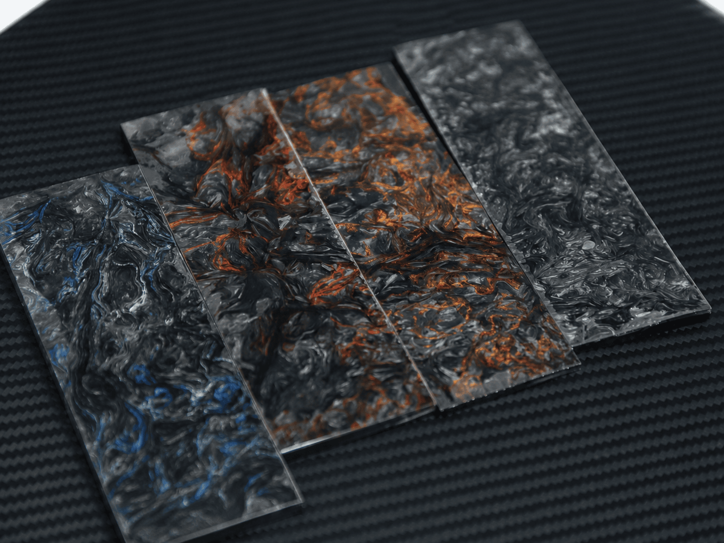
What Is a Forged Carbon Fiber Sheet?
A forged carbon fiber sheet is a flat panel produced by compression molding a mixture of chopped carbon fiber strands and resin under controlled heat and pressure. The result is a rigid, lightweight panel with forged carbon fiber’s characteristic flowing, marble-like surface pattern.
Unlike woven carbon fiber sheets, which show a regular grid weave, forged carbon fiber sheets display a random, organic texture that varies across every panel and from piece to piece. No two sheets are identical.
Why sheets matter: forged carbon fiber sheets can be used directly in flat form, or cut and CNC machined into smaller components, inlays, rings, bezels, panels, handles, and shallow three-dimensional product geometries.
Technical material suppliers often provide datasheets and specification resources because product development decisions depend on measurable material data. For a general example of how advanced composite manufacturers organize technical material information, you can review Toray Advanced Composites.
Forged Carbon Fiber Sheet Thickness: 0.3mm to 30mm
Carbonaurum produces forged carbon fiber sheets across a wide thickness range — from 0.3mm at the thinnest end to 30mm for solid block-like panels. This range covers many applications in luxury goods, consumer products, jewelry, accessories, and industrial design.
Ultra-Thin Sheets
0.3mm–1mm for overlays, veneers, watch dials, jewelry inlays, thin decorative panels, and small precision inserts.
Standard Panels
1mm–6mm for card holders, money clips, pen wraps, knife scales, eyewear components, trim parts, and product housings.
Thick Panels & Blocks
6mm–30mm for ring blanks, pen barrel blanks, thick handle blocks, structural inserts, and CNC-machined components.
Ultra-Thin Sheets: 0.3mm – 1mm
At the thinnest end of the range, forged carbon fiber sheets become overlays, veneers, and inlay materials. 0.3mm–0.5mm sheets are used primarily as decorative overlays bonded to a substrate material to add the visual character of forged carbon fiber without the full thickness of a structural panel.
Typical applications include watch dials, inlay inserts for jewelry settings, decorative face panels for electronics, and thin veneer applications in luxury packaging and accessories. At this thickness, the material requires careful handling during processing. CNC cutting and laser cutting are commonly used, and edge finishing must be done with precision.
0.6mm–1mm sheets are commonly used for jewelry inlays and thin overlay applications that require slightly more structural integrity. Ring face inlays, pendant surfaces, and cufflink faces are typical applications in this range.
Standard Panels: 1mm – 6mm
This is the most widely used thickness range across the majority of applications. 1mm–2mm sheets work well for card holders, money clip bodies, pen barrel wraps, small automotive trim accents, and watch bezel inserts.
3mm–4mm sheets are suited to more substantial component production: knife handle scales, eyewear frame sections, thicker jewelry components, gear knob caps, and interior trim pieces. At this thickness, the material machines cleanly and holds edge detail well.
5mm–6mm sheets move into the range where the panel can function as a structural component rather than purely a surface material. Pen barrels, thicker handle scales, structural jewelry components, and product housings can use this thickness range.
Thick Panels: 6mm – 30mm
Above 6mm, forged carbon fiber sheets transition from sheet material to what is more accurately described as a block or slab — a solid piece of forged carbon fiber that is typically machined into a finished component rather than used as a flat sheet.
6mm–15mm panels are used for ring blanks, thick knife handle scales, pen barrel blanks, and any application where the component needs to be turned or milled from solid material.
15mm–30mm panels represent the thickest production capability currently available at Carbonaurum. At this scale, the material behaves more like a block than a sheet. These thick panels are used for substantial machined components: large ring blanks, structural inserts, thick handle blocks, and custom industrial parts.
Practical note: the deeper the panel, the more the internal pattern of forged carbon fiber becomes visible when the part is machined. A ring turned from a 12mm blank will show the flowing interior pattern at its cut faces and surfaces.
Thickness Summary Table
| Thickness Range | Typical Applications |
|---|---|
| 0.3mm – 0.5mm | Watch dials, decorative overlays, jewelry inlays, veneer applications |
| 0.6mm – 1mm | Ring face inlays, pendant surfaces, cufflink faces, thin overlays |
| 1mm – 2mm | Card holders, money clips, pen wraps, thin automotive trims |
| 3mm – 4mm | Knife scales, eyewear components, thicker jewelry parts, interior trims |
| 5mm – 6mm | Pen barrels, structural handles, product housings, thick jewelry components |
| 6mm – 15mm | Ring blanks, thick handle scales, pen barrel blanks, machined components |
| 15mm – 30mm | Large ring blanks, structural inserts, thick handle blocks, custom industrial parts |
Forged Carbon Fiber Panel Sizes and Custom Options
The largest standard panel size currently available from Carbonaurum is 420 × 500mm. This dimension reflects the size of our largest production mold.
Panels at this size provide significant yield when cut into smaller components. A single 420 × 500mm sheet can produce a large number of ring blanks, inlay pieces, or handle scales depending on the component geometry.
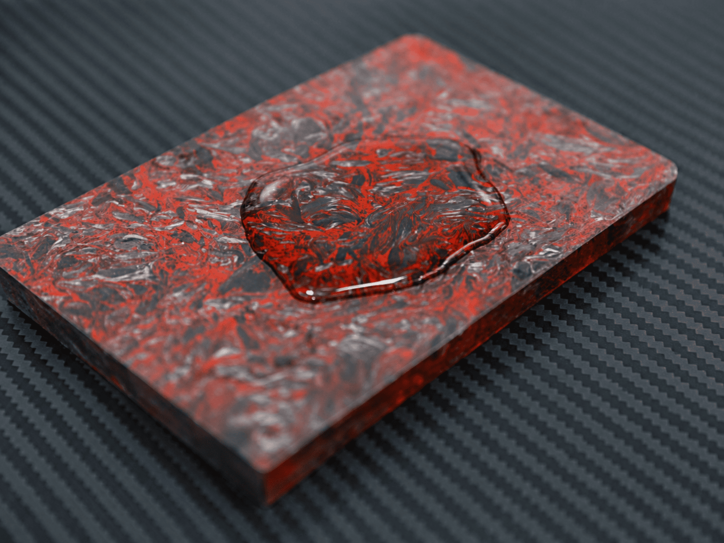
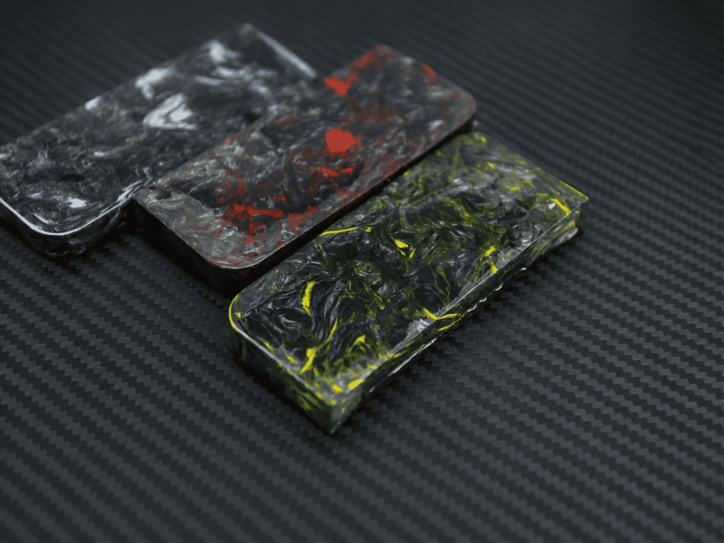
Smaller Standard Panel Sizes
We maintain multiple mold sizes in production, which means panels are available in a range of dimensions smaller than the maximum. If your application requires a specific panel size smaller than 420 × 500mm, contact us to discuss current mold availability and which dimensions best match your requirements.
Custom Panel Sizes
For applications that require panels larger than 420 × 500mm, custom mold fabrication is possible. This is relevant for brands that need large-format panels for automotive trim applications, architectural elements, or high-volume component production where larger sheet size improves cutting yield.
Custom mold development involves tooling investment and lead time. Contact our team to discuss feasibility for your specific requirements.
CNC Cutting to Custom Shapes and Dimensions
One of the key advantages of starting with a standard panel is the flexibility of downstream CNC machining. Once a panel is produced, it can be cut to smaller rectangular or square dimensions, profiled into complex shapes, drilled, routed, engraved, or turned on a lathe for cylindrical applications such as ring blanks and pen barrels.
Because cutting, grinding, and machining composite materials can generate dust, buyers and manufacturers should plan proper dust extraction and protective measures. OSHA’s composites overview provides a useful general reference for workplace considerations when handling composite materials: OSHA Composites Overview.
This means standard panel sizes are not a limitation on final component geometry. A 420 × 500mm sheet is effectively a raw material from which many flat or machined components can be produced.
Colors and Pattern Scales
Carbonaurum has developed more than 50 distinct colors for forged carbon fiber sheet production. These span the full visual spectrum — from deep blacks and dark navies through vivid reds, electric blues, forest greens, warm gold tones, and neutral grays.
Colors are integrated into the fiber matrix itself, not applied as a surface coating. This means the color is present throughout the full thickness of the sheet — visible at cut edges, machined surfaces, and at any depth of machining.
For a full view of available colors, visit our internal Color Gallery. If you want to understand how colored carbon fiber differs from standard black material, read our guide: Colorful Carbon Fiber vs Black Carbon Fiber.
Pattern Scale Options
An important specification parameter that is often overlooked by first-time buyers is pattern scale — the physical size of the flowing fiber pattern visible on the sheet surface.
Fine Pattern
Best for small components where the detail needs to read at close range: jewelry pieces, ring faces, watch dials, and small inlays.
Medium Pattern
A balanced scale for pen barrels, card holders, handle scales, and mid-size automotive trim components.
Large Pattern
Best for larger surface areas such as automotive panels, laptop covers, larger accessories, and bold visual applications.
Selecting the wrong pattern scale for a component size is one of the most common specification errors. A large-pattern sheet applied to a small component may show only a partial fragment of the pattern, losing the visual coherence of the flowing marble effect.
For jewelry applications specifically, fine pattern sheets are often the correct choice. For finished forged carbon fiber jewelry OEM projects, you can also visit our related jewelry manufacturing site: Ringentle.
Surface Finishes for Forged Carbon Fiber Sheets
Carbonaurum forged carbon fiber sheets are available in two primary surface finishes: high gloss and matte / satin.
High Gloss
High gloss is the default and most widely specified finish. A high-gloss surface maximizes the visual depth of the forged carbon fiber pattern. The reflective surface creates a three-dimensional quality as the pattern catches light from different angles.
Gloss finish is standard for luxury goods, jewelry, watches, and premium accessories where visual impact is the priority. Gloss panels have a hard, clear top surface that provides good scratch resistance and a premium tactile quality.
Matte / Satin
A matte or satin finish diffuses surface reflection, reducing visual glare and creating a softer, more understated aesthetic. Some brands prefer matte for its tactile quality and more technical appearance.
Matte finish is a good choice for automotive interior applications, certain consumer electronics, and accessory brands that want a restrained, functional aesthetic rather than a high-shine luxury look.
A Note on Other Finish Options
We have explored additional surface treatments including brushed finishes and hammered textures. While these are technically achievable, our assessment after development work is that neither finish enhances the visual character of forged carbon fiber in the way that gloss and matte do.
The flowing marble pattern of the material is best expressed through smooth surface finishes that allow the pattern to read clearly. We continue to explore new finishing directions and will update our offering as new options are validated.
Sourcing Forged Carbon Fiber Sheets from Carbonaurum
Carbonaurum maintains inventory of forged carbon fiber sheets across our standard thickness range and developed color palette. There is no minimum order quantity for sheet material — we supply from existing inventory based on current stock levels.
Because inventory levels vary, we recommend contacting our team directly to confirm availability of your required specification before finalizing project timelines.
Custom Orders
For specifications not available from stock — custom colors, custom dimensions, non-standard thicknesses, or larger volume requirements — custom production can be arranged. Custom orders involve development and production lead time depending on specification complexity.
Requesting Samples
Physical samples are the most reliable way to evaluate forged carbon fiber for your application. Color, pattern scale, and surface finish all have properties that are difficult to assess from photographs alone.
We recommend requesting samples in your target color, pattern scale, and surface finish before committing to production quantities. Sample requests can be made through our contact page.
Choosing the Right Specification: A Quick Decision Framework
If you are unsure where to start, the following questions will quickly narrow your specification.
Best starting point: request physical samples before production. Forged carbon fiber is a visual and tactile material, so color, gloss, thickness, and pattern scale should be evaluated in person whenever possible.
Conclusion
Forged carbon fiber sheets from Carbonaurum are available across a wide specification range: 0.3mm to 30mm in thickness, panels up to 420 × 500mm, more than 50 developed colors across multiple pattern scales, and gloss or matte surface finishes.
Whether you are sourcing material for jewelry inlays, knife handle scales, watch components, automotive trims, consumer electronics, or luxury accessories, the right specification exists within our current range — or can be developed for your specific requirements.
The best starting point is always a physical sample. Contact our team to request samples or discuss your project.
Need Forged Carbon Fiber Sheets for Your Project?
Carbonaurum supplies forged carbon fiber sheets, colored forged carbon fiber panels, thick blocks, and custom CNC-ready material for product designers, brands, and manufacturers.