
What Is Forged Carbon Fiber Made Of? Materials, Process, and Structure Explained
A technical guide to forged carbon fiber composition: carbon fiber tow, fiber length, resin systems, color chemistry, compression molding, and how process choices affect the final pattern and performance.
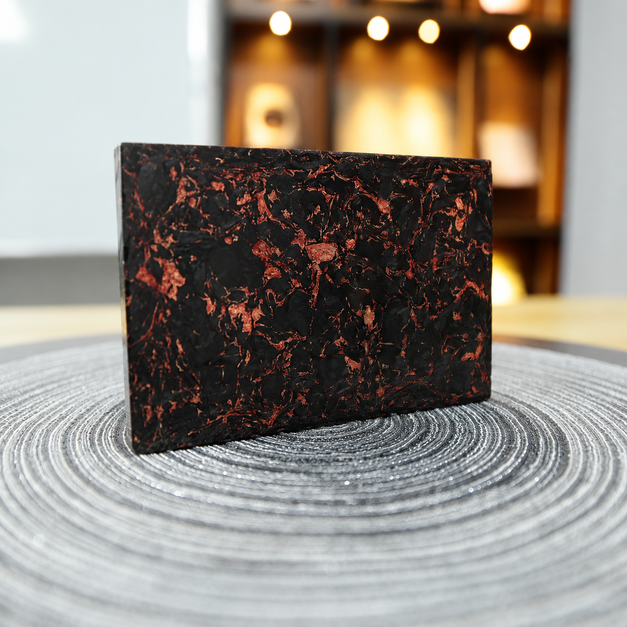
What is forged carbon fiber made of? At its core, forged carbon fiber is a composite material made from chopped carbon fiber strands, epoxy resin, and carefully controlled process variables that determine the final pattern, color, surface quality, and mechanical behavior.
Forged carbon fiber has become one of the most recognizable advanced materials in premium product design. Its flowing, marble-like surface pattern and excellent strength-to-weight ratio have made it a material of choice for luxury goods, high-performance accessories, and precision-engineered components.
But forged carbon fiber is not simply “carbon fiber mixed with resin.” The specific material choices — fiber type, fiber length, resin system, color chemistry, fiber volume fraction, mold design, and compression parameters — all translate directly into the visual and mechanical properties of the finished material.
The Two Core Components
Forged carbon fiber is a composite material. Like all composites, it consists of two fundamental components:
Reinforcement: Carbon Fiber Strands
Carbon fiber strands provide mechanical strength, stiffness, lightweight performance, and the characteristic visual pattern of forged carbon fiber.
Matrix: Epoxy Resin
Epoxy resin binds the fibers together, transfers load between them, fills the mold cavity, and forms the continuous solid structure of the finished panel.
The ratio, arrangement, and specific grade of each component determine the properties of the finished material — both mechanical and visual. For general background on carbon fiber and composite reinforcement systems, references from major carbon fiber producers such as Toray Carbon Magic / Toray carbon materials provide useful context on the broader carbon fiber industry.
Carbon Fiber Tow: The Reinforcement
What Is Carbon Fiber Tow?
Carbon fiber begins as a precursor material — most commonly polyacrylonitrile, also known as PAN — which undergoes controlled oxidation and carbonization at very high temperatures. This process drives off non-carbon elements and aligns the remaining carbon atoms into a structure with exceptional tensile strength and stiffness along the fiber axis.
The result is carbon fiber filament: individual strands with a diameter of approximately 5–7 micrometers, much thinner than a human hair. These filaments are bundled together into what the industry calls a tow, designated by the number of filaments it contains.
Tow Size: Why 3K?
Tow size is expressed in thousands of filaments. Common sizes include 1K, 3K, 6K, 12K, and 24K. Larger tow sizes contain more individual filaments in each bundle.
| Tow Size | Filament Count | Typical Use |
|---|---|---|
| 1K | 1,000 filaments | Aerospace precision components and very fine composite work |
| 3K | 3,000 filaments | Premium composites, detailed pattern work, jewelry, watches, and luxury accessories |
| 6K | 6,000 filaments | General structural composites |
| 12K | 12,000 filaments | High-volume structural applications |
| 24K | 24,000 filaments | Industrial and cost-driven applications |
Carbonaurum primarily uses 3K tow as its standard input for forged carbon fiber production. The reason is pattern quality. Finer tow produces finer individual fiber bundles when chopped. When these smaller bundles are distributed and compressed, they create a tighter and more detailed flowing pattern with greater visual intricacy.
For applications like jewelry, watch components, and luxury accessories — where the component is viewed up close and pattern quality matters — 3K tow is the correct choice. The visual difference is immediately apparent when comparing samples side by side.
Domestic vs. Imported Fiber
Carbon fiber tow is produced by a relatively small number of manufacturers globally. The most widely recognized include Toray, Hexcel, Teijin, and a growing number of Chinese producers.
Carbonaurum primarily uses domestic Chinese carbon fiber tow. This is a deliberate material decision, not a cost compromise. For forged carbon fiber — where the fiber is chopped, randomized, and compression molded — the visual pattern output of domestic 3K tow is highly suitable at equivalent tow size. The flowing marble pattern is mainly a function of fiber bundle geometry, fiber length, distribution, resin flow, and compression parameters.
Using domestic fiber allows Carbonaurum to maintain stable supply, competitive pricing, and production flexibility without compromising the visual or functional quality of the finished material for the applications we serve.
Fiber Length: The Pattern Control Variable
Why Fiber Is Chopped
Unlike woven carbon fiber — where long continuous tows are interlaced in a structured grid — forged carbon fiber uses chopped fiber. These short segments are cut from continuous tow before processing.
Chopping serves two purposes. First, it allows the fiber to flow and redistribute during compression molding, enabling the material to fill mold geometries that continuous fiber could not easily conform to. Second, chopping creates the discrete fiber bundle segments whose random arrangement produces the flowing marble pattern.
Fiber Length Is a Design Variable
There is no single standard fiber length for forged carbon fiber. Fiber length is a process variable that directly controls pattern scale and visual character.
Shorter fiber segments produce tighter, finer patterns with more frequent directional changes across the panel surface. Longer fiber segments create broader, more sweeping flow lines — a bolder, more open pattern.
At Carbonaurum, fiber length is adjusted according to each pattern specification. When we develop a new color or pattern variant, fiber length is one of the primary parameters we tune to achieve the target visual result.
Short-Cut and Long-Cut: Two Distinct Production Processes
Beyond general fiber length variation, Carbonaurum produces forged carbon fiber using two distinct fiber length categories, each developed for a specific product form.
Short-Cut Fiber: 30–50mm
Short-cut fiber is the standard input for forged carbon fiber sheet production. It creates the flowing marble pattern across flat panels and can also be used to produce rod stock with a tighter, more segmented pattern.
Long-Cut Fiber: Up to 1000mm
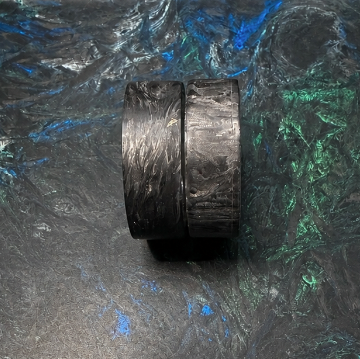
Long-cut fiber is used for dedicated rod stock production, especially for rings. It produces longer, more continuous flow lines that wrap around the ring more smoothly.
Short-cut fiber can be produced across Carbonaurum’s full color range of 50+ developed colors. It is suitable for sheets, panels, blocks, and colored rod stock where color variety and pattern density are important.
Long-cut fiber is currently used for natural carbon fiber rod stock. It creates a more continuous, marble-like flow, especially visible in finished rings. This process uses dedicated rod mold geometry and different press settings from flat sheet production. The direction and magnitude of compressive force applied to rod stock differs from flat panel molding, making it a separately engineered process rather than a simple adaptation of sheet production.
Practical choice: for colored forged carbon fiber rings, short-cut rod stock is the right choice because it supports the full color range. For buyers prioritizing the most continuous natural black-and-gray marble flow, long-cut natural-color rod stock is the correct option.
One characteristic unique to forged carbon fiber is the optical behavior of the individual carbon fiber filaments. Carbon fiber is not simply flat black. Under light, each filament reflects at a slightly different angle, producing a surface that shifts between deep black and silver-gray depending on viewing angle and light direction.
Every piece is unrepeatable. Unlike woven or prepreg carbon fiber, where machine-controlled fiber alignment produces predictable repetition, forged carbon fiber patterns are determined by the physics of fiber flow, compression, resin distribution, and curing. No two pieces of forged carbon fiber — whether sheet, rod, or finished ring — will ever carry exactly the same pattern.
To compare available material formats, you can also read our internal guide: Forged Carbon Fiber Sheets: Thickness, Sizes, and Specifications Guide.
The Resin Matrix: Epoxy and Color Chemistry
Epoxy Resin as the Base Matrix
Forged carbon fiber uses epoxy resin as its matrix material. Epoxy is widely used in high-performance carbon fiber composites because it bonds well to carbon fiber surfaces, has low shrinkage during cure, provides useful mechanical properties after curing, and is compatible with additives and color systems.
The epoxy system used in forged carbon fiber is formulated for compression molding. It needs the right viscosity, pot life, and cure kinetics to flow with the fiber under heat and pressure, fill the mold completely, and cure into a solid matrix within the molding cycle.
How Color Works in Forged Carbon Fiber
Carbon fiber itself is black. In standard uncolored forged carbon fiber, the black fiber is visible through the cured resin, producing the classic dark gray-to-black marble appearance.
To produce colored forged carbon fiber, pigmentation and additional color components must be introduced into the material system. This is not simply a matter of adding paint pigment to resin. Achieving rich, consistent, stable colors throughout the full material thickness requires a more sophisticated approach.
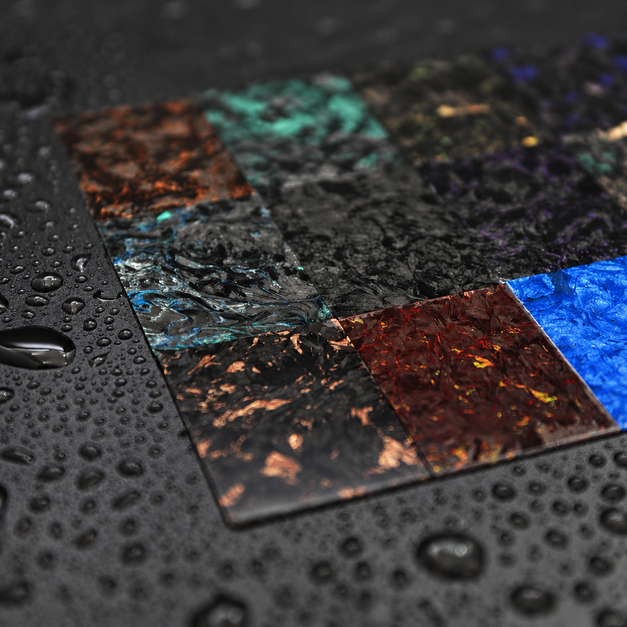
At Carbonaurum, the color system involves multiple components introduced alongside the epoxy resin. These components interact with the resin and fiber to produce colors that are present throughout the full depth of the material — not just at the surface.
When a colored forged carbon fiber panel is cut or machined, the color remains visible at the cut edge and throughout the cross-section. This is what distinguishes color-integrated forged carbon fiber from black carbon fiber coated with colored paint or lacquer.
Over 50 distinct colors have been developed and validated for production, each requiring its own formulation calibration to achieve the correct visual result, batch consistency, and compatibility with the epoxy cure cycle. Browse our internal Color Gallery to see current available color directions.
Compression Molding: The Process That Creates the Pattern
How Compression Molding Works
Once the chopped fiber and resin system are prepared, the material is loaded into a mold and subjected to heat and pressure in a hydraulic press. This process — compression molding — is what gives forged carbon fiber its name and its defining visual character.
The press forces the fiber-resin mixture to flow and consolidate under controlled conditions. As the material flows to fill the mold cavity, the fiber bundles orient themselves along the flow paths, creating the directional yet random pattern that is characteristic of forged carbon fiber.
Production Parameters at Carbonaurum
Carbonaurum does not rely on one fixed press setting for all products. We use hydraulic presses with different tonnage levels and adjust the press parameters according to product type, mold size, panel thickness, rod geometry, target fiber consolidation, color system, and surface quality requirements.
Flat sheets, thick panels, rod stock, and specialty pattern products each require different pressure profiles, temperature curves, and cycle times. A thin sheet does not need the same molding logic as a thick block; a rod blank does not behave the same way as a flat panel; and colored resin systems may require additional calibration compared with natural black forged carbon fiber.
Key point: press tonnage is not a marketing number. The correct tonnage depends on mold area, product thickness, resin flow, target consolidation, and final application. Carbonaurum selects suitable press capacity and parameters for each product specification instead of applying a single fixed process to every material.
| Parameter | Typical Consideration |
|---|---|
| Press capacity | Selected according to mold area, product type, thickness, and target consolidation |
| Mold temperature | Usually calibrated around the curing behavior of the epoxy resin system |
| Cure cycle | Adjusted according to thickness, color formulation, and required surface quality |
| Pressure profile | Calibrated to control void content, fiber distribution, resin flow, and pattern quality |
General technical background on compression molding and composite processing can be found in resources from manufacturing and composite industry organizations such as CompositesWorld. Precise parameters for Carbonaurum products are determined during process development and are not disclosed because they represent process know-how.
Why Press Parameters Matter
Insufficient pressure can produce panels with higher void content — microscopic air pockets in the cured matrix that reduce mechanical quality and may cause surface defects. Excessive pressure can cause resin bleed-out, fiber starvation at panel edges, and dimensional inconsistency.
Temperature controls cure kinetics. If temperature is too low, the resin may not fully cure. If it is too high, thick panels may develop internal stress or surface defects. Cycle time must be long enough for heat to penetrate the material without over-curing the surface.
Getting these parameters right — and maintaining them consistently across production batches — is the difference between a clean, stable forged carbon fiber panel and one with voids, surface defects, or color inconsistency.
Fiber Volume Fraction: Balancing Strength and Pattern
What Is Fiber Volume Fraction?
Fiber volume fraction is the percentage of the total material volume occupied by carbon fiber, as opposed to resin. It is one of the most important structural parameters in any composite material.
In unidirectional or woven carbon fiber composites designed for maximum structural performance, higher fiber content generally means higher stiffness and strength — up to the point where there is insufficient resin to fully wet and bond all fiber surfaces.
Carbonaurum’s Target Range: 40–50%
Carbonaurum targets a fiber volume fraction of approximately 40–50% for forged carbon fiber sheet production. This range is lower than highly structural aerospace composites, and deliberately so.
Forged carbon fiber is often used in luxury goods, accessories, jewelry, watch components, product housings, and precision components where visual pattern quality, surface finish, machining quality, and edge quality are important.
A higher fiber fraction could change the flow characteristics of the material during molding, making it harder to achieve the smooth, flowing pattern that defines forged carbon fiber’s visual character. It could also make the material more brittle and more difficult to machine cleanly.
Balance matters: at 40–50% fiber volume fraction, forged carbon fiber can achieve meaningful mechanical performance while maintaining pattern quality, machinability, color integration, and a premium surface finish.
The Resulting Material Structure
Isotropic vs. Anisotropic
Standard woven or unidirectional carbon fiber is anisotropic — its mechanical properties differ depending on direction. Tensile strength along the fiber axis can be much higher than strength perpendicular to the fiber direction.
Forged carbon fiber is approximately isotropic within the plane of the panel. This is because the random fiber orientation distributes reinforcement in multiple directions rather than concentrating it along one axis.
For many applications, this is an advantage. A knife handle, watch bezel, card holder, or ring blank does not experience load primarily along a single axis. It experiences forces from multiple directions, so a more balanced material structure can be beneficial.
Visual Structure
The flowing pattern visible on a forged carbon fiber surface is a direct map of fiber bundle orientation at the panel surface. Beneath the surface, fiber bundles continue through the thickness at varying orientations, interlocking in a three-dimensional structure.
Because the pattern is three-dimensional, not just a surface effect, machining into the panel reveals new pattern at each depth. Rings turned from thick blanks show pattern on the inner bore as well as the outer face; machined pockets and countersinks expose pattern on their side walls.
This structural continuity between surface appearance and internal structure is what distinguishes genuine forged carbon fiber from printed films, surface coatings, or imitation textures.
Summary
Forged carbon fiber is produced from carbon fiber tow, epoxy resin, and color chemistry, combined through a controlled compression molding process. Each variable in that process is a design choice with consequences for the visual and mechanical properties of the finished material.
| Variable | Effect on Final Material |
|---|---|
| Tow size | Controls pattern fineness and fiber bundle scale |
| Fiber length | Controls pattern scale — shorter fibers create finer patterns, longer fibers create bolder flow |
| Short-cut vs. long-cut | Determines product form and pattern continuity, especially in rings and rod stock |
| Resin and color system | Determines color, translucency, matrix properties, and edge color consistency |
| Press parameters | Determine consolidation quality, surface finish, void content, and color stability |
| Fiber volume fraction | Balances mechanical performance with pattern quality and machinability |
Understanding these variables is what allows a specialist manufacturer to produce forged carbon fiber with consistent, predictable visual results — and to develop new colors and patterns that perform reliably across production batches.
For product designers and brands working with forged carbon fiber for the first time, the most important practical implication is this: the material you receive is a direct result of the process choices your manufacturer has made. Evaluating samples before committing to production is not optional — it is the best way to verify that those choices have produced the result your product requires.
Need Forged Carbon Fiber Samples?
Carbonaurum supplies forged carbon fiber sheets, colored forged carbon fiber materials, rod stock, ring blanks, and custom material solutions for brands, product designers, and manufacturers.